
Augmentative & Alternative Communication (AAC)
Empowering Communication Through AAC Tools & Support
For children who face significant speech challenges, AAC opens a world of connection. We help your child communicate their needs, thoughts, and feelings — in the way that works best for them.
What is AAC?
Finding the Right Voice — Even Without Spoken Words
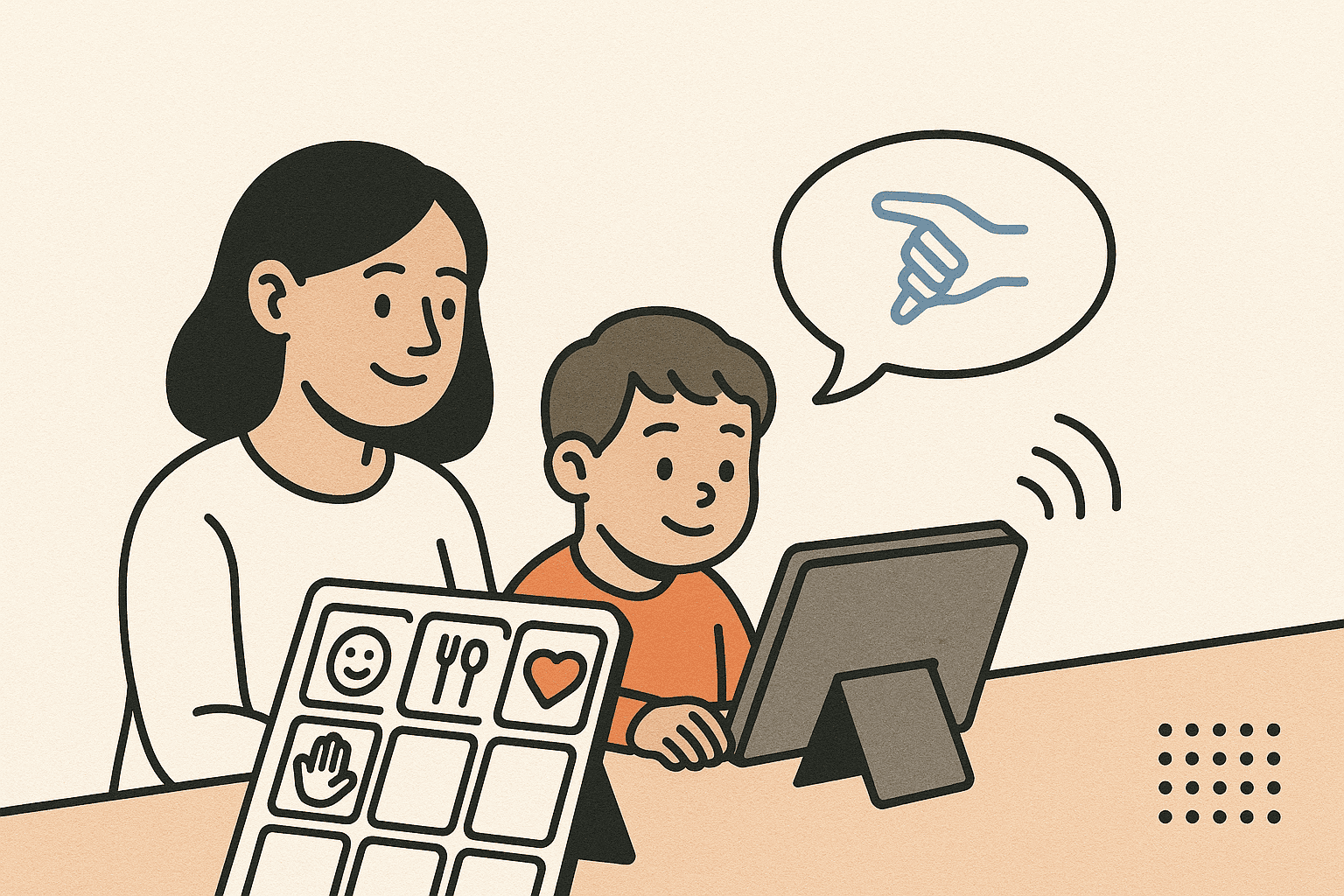
AAC (Augmentative and Alternative Communication) includes tools and techniques — from picture boards to high-tech devices — that give children a reliable way to express themselves.
Low-Tech AAC
Communication boards, picture cards, PECS (Picture Exchange Communication System), and gestures.
Mid to High-Tech AAC
Speech-generating devices (SGDs), tablet-based communication apps, and customized AAC systems.
Custom AAC Planning
We assess your child’s unique communication needs and build a plan around what will truly work for them.
Family Training & Support
We guide parents and caregivers every step of the way to ensure success beyond the therapy room.
Communication That Grows
Building a Foundation for Connection and Independence
With the right tools and guidance, AAC helps children move from frustration to interaction, from silence to expression.
Increased Independence
Children can make choices, ask for help, and share their thoughts — all on their own terms.
Social Interaction Support
AAC builds confidence in communicating with peers and adults in daily settings.
Academic Inclusion
Students can participate more fully in classroom routines and learning.
Emotional Expression
Kids learn to express their feelings, wants, and experiences — a crucial step in their development.
Flexible, Child-Centered AAC Therapy
Tic-Talk-Toe offers flexible formats to meet your needs—whether that’s from the comfort of your home or in our engaging learning spaces.
01
In-Person AAC Support
Hands-on device exploration, setup, and training tailored to your child’s goals.
02
Virtual AAC Coaching
Remote sessions that support device use, maintenance, and family-led strategies at home.
What Is Augmentative & Alternative Communication (AAC)?
Augmentative and Alternative Communication — commonly known as AAC — refers to any tool, strategy, or method that supports or replaces spoken language for individuals who have difficulty communicating verbally. AAC can be as simple as a picture board or as sophisticated as a speech-generating device or tablet-based communication app.
AAC is not a last resort — it is a powerful, evidence-based approach that gives children who struggle to speak a way to communicate, connect, and participate fully in their world. Research consistently shows that AAC does not prevent children from developing speech — in fact, it often supports and accelerates spoken language development.
At Tic-Talk-Toe Speech and Language Therapy in Raleigh, NC, we are passionate about AAC and committed to helping every child find their voice — in whatever form that takes.
Who Is AAC For?
AAC can benefit a wide range of children, including those with:
- Autism Spectrum Disorder (ASD)
- Childhood Apraxia of Speech (CAS)
- Cerebral Palsy
- Down Syndrome
- Developmental language disorders
- Genetic syndromes affecting communication
- Acquired conditions affecting speech
- Any condition that limits a child’s ability to communicate verbally
There is no minimum age requirement for AAC — even very young children can benefit from AAC support. And there is no cognitive requirement either — AAC is appropriate for children of all ability levels.
If your child is non-verbal or minimally verbal and struggling to communicate, AAC may be exactly the support they need. A free screening at Tic-Talk-Toe Speech and Language Therapy in Raleigh, NC is the best place to start.
What Types of AAC Are Available?
AAC comes in many forms and is always customized to the individual child’s needs, abilities, and communication goals. Common types include:
- Low-tech AAC — picture boards, communication books, PECS (Picture Exchange Communication System)
- Mid-tech AAC — simple speech-generating devices with pre-recorded messages
- High-tech AAC — tablet-based apps like Proloquo2Go, TouchChat, or LAMP Words for Life that generate synthesized speech
- Unaided AAC — sign language, gestures, and facial expressions that don’t require any external device
At Tic-Talk-Toe Speech and Language Therapy, we evaluate each child carefully to determine which type of AAC system is the best fit — and then we teach the child, family, and any other communication partners how to use it effectively.
What Does AAC Therapy Look Like at Tic-Talk-Toe?
AAC therapy at Tic-Talk-Toe Speech and Language Therapy goes far beyond simply selecting a device. Our approach is comprehensive, family-centered, and built around your child’s unique communication profile.
Therapy includes:
- AAC evaluation — assessing your child’s communication needs, motor skills, and cognitive abilities to determine the most appropriate AAC system
- Device setup and customization — programming vocabulary and settings to match your child’s needs and interests
- AAC implementation — teaching your child to use their AAC system functionally across a variety of settings and situations
- Communication partner training — teaching parents, caregivers, siblings, and teachers how to model AAC and support your child’s communication
- Aided language stimulation — modeling language using the AAC system so your child sees it used in real communication
- Ongoing progress monitoring — adjusting vocabulary, goals, and strategies as your child grows and develops
We are strong believers that communication is a basic human right — and every child deserves a reliable way to express themselves, regardless of their verbal abilities.
Sessions are available in-person at our Raleigh, NC clinic, via teletherapy, and in home or school settings across the Triangle area.
Every Child Deserves a Voice.
If your child is non-verbal, minimally verbal, or struggling to communicate, AAC could be life-changing. Tic-Talk-Toe Speech and Language Therapy serves families across Raleigh, Durham, Cary, Wake Forest, and the greater Triangle area of North Carolina. Book a free screening today and let’s find the right communication solution for your child.